

Don't Let Your AI Agent Delete Your Production Database

You've probably seen the posts. An AI coding agent wipes a production database during a code freeze, or escalates a schema warning into dropping 87 tables, or deletes an RDS instance along with its snapshots. Then it apologizes, but the harm is already done.
It's easy to sneer at the unlucky developer who gave their agent keys to the production database. But managing a database is hard, and we ought to be able to delegate it to an agent and expect it to be handled safely, without, say, deleting everything in it.
These catastrophic failures aren't really agent failures. They're tool failures. For decades, the dominant position of database tooling has been: be sure you know what you're doing, or you might lose data, and if you do, that's your fault. That's a big problem for new users and happy-go-lucky agents alike. Agents just stumble into the pitfalls faster.
We built Prisma 8 (formerly Prisma Next) so your agent can manage your database safely. Not with sterner warnings, but by removing the footguns from the tool, so these mistakes aren't possible in the first place.
Why AI agents delete databases
Most agent-caused data loss traces back to a handful of schema admin commands: the commands that change the structure of your tables and their relationships.
The worst offender historically was prisma migrate reset, a command that wipes the database completely. It was meant as a development-time tool for starting from scratch, but older versions of Prisma suggested it whenever the database got into a state they couldn't manage. Unsurprisingly, people, and later their agents, deleted their databases. It was, after all, the next step in a process they trusted prisma to keep safe.
In the same vein are commands that update the database to match the schema recorded in the codebase: prisma db push, drizzle-kit push --force, and friends. These are intended for development, but to an inquisitive agent they look like a fine way to update a running production database. Never mind that they will blithely delete any data that no longer matches the schema.
And then there are migrations themselves, a vertigo-inducing pitfall for humans and agents alike, and the place where tools have historically done almost nothing to protect you from your own mistakes. A migration is a file of SQL commands that runs in order. That's it. No protections, no guardrails, no verification. If you mess up, it's on you.
Warnings don't work on AI agents
Every tool above has innocent intentions: commands meant for development only, protections you can override with a --force flag when you're sure.
But agents often don't respect warnings. If bypassing a protection looks like the way to reach their goal, they will bypass it. They don't even have to look hard. When a warning blocks a non-interactive run, the tool's own error text names the bypass:
Use --force to run this command without user interaction.Use the --accept-data-loss flag to ignore the data loss warningsAn agent's goal is a green exit code, so it does what the error says. That's how one schema-field request became 87 dropped tables: the .env pointed at production, and nothing in the tool knew or checked.
For years, classic Prisma's answer to migration drift was a prompt: "We need to reset the database… All data will be lost." One y away from disaster. We've since hardened what a human-era CLI can harden. Prisma 6.5 stopped offering resets, and 6.15 refuses the most destructive commands from detected agents until a human explicitly consents. Other tools in the ecosystem have their own equivalents, with their own sync modes and force flags.
But this isn't enough. The fix isn't a better warning. It's a system where the catastrophic action can't be initiated at all.
How Prisma 8 makes schema changes safe
In Prisma 8, your schema is a contract between your application and the database: it records every table, field, and index your application depends on.
Prisma's job is to make sure your database satisfies your contract, and that your application's queries and TypeScript types match it too.
The way you change your database is by changing your contract. Each time you do, you tell Prisma to bring the database up to date, which it does by writing and executing migrations.
For an agent, just like a human, that reduces the job to: describe what you want, ask the system to make it true, go back to writing your app. We didn't add warnings to make this safe for agents. We took away the dangerous actions entirely.
There is no reset command
There is no reset in Prisma 8, and no "delete the database" command at all. You can't say yes to a prompt that is never shown, and you can't override with a --force flag that isn't offered. You can update your development database without the ceremony of migrations using db update, which stops whenever a change would destroy data.
Interactively, it asks: "Apply destructive changes? This cannot be undone." Non-interactively, it refuses with a structured error listing exactly which operations would destroy data, in meta.destructiveOperations[]. There is a -y flag to accept, but the difference is what you're accepting. Classic force flags were blank cheques: --accept-data-loss meant "whatever this turns out to destroy, fine", and behind it stood a bigger hammer in --force-reset. db update -y accepts only the operations enumerated in the current plan: drop this column, drop this table. There is no bigger hammer behind it. The worst db update can do is move your database toward your contract. To empty the database, you'd have to empty the contract first, in plain view of review.
There is no shadow database
To plan a migration, classic Prisma needed a second, disposable database, the shadow database, where it replayed your entire migration history to work out what your real database should look like. Prisma usually creates and deletes it automatically, but hosted providers often don't allow that, so you supply one yourself through shadowDatabaseUrl. A shadow database gets wiped at the start of every run, with no prompt. That's its job. Which means one connection string pasted into the wrong field turns "plan a migration" into "silently erase a real database". The docs can only warn: "Do not use the exact same values for url and shadowDatabaseUrl as that might delete all the data in your database."
That's not a hypothetical. In late July 2026, ten minutes into an agent session, a developer watched every table in their production Supabase instance turn up empty. And Supabase is exactly the kind of hosted provider where the shadow database is configured by hand.
Prisma 8 doesn't need one. A migration is calculated by comparing two versions of your contract, the one your database is at and the one you want it to have, entirely offline, without connecting to any database. There is no scratch database to configure, so there is nothing to point at the wrong place.
You can't run the wrong migration
Every Prisma 8 database carries a marker: a record of exactly which version of the contract it currently satisfies. Every migration declares the version it starts from and the version it produces. If the database isn't at the migration's exact starting point, the migration refuses to run, before any mutation executes.
Wrong .env, wrong connection string, drifted database, half-applied migration: every one of these stops with a refusal and a diagnosis, instead of executing against a database it wasn't planned for.
Migrations check their own work
A Prisma 8 migration compiles to operations that carry their own verification. Here's a real one:
{
  "id": "column.user.phone",
  "label": "Add column \"phone\" to \"user\"",
  "operationClass": "additive",
  "precheck": [
    {
      "description": "ensure column \"phone\" is missing",
      "sql": "SELECT NOT EXISTS (SELECT 1 FROM information_schema.columns WHERE …)"
    }
  ],
  "execute": [
    {
      "description": "add column \"phone\"",
      "sql": "ALTER TABLE \"user\" ADD COLUMN \"phone\" text"
    }
  ],
  "postcheck": [
    {
      "description": "verify column \"phone\" exists",
      "sql": "SELECT EXISTS (SELECT 1 FROM information_schema.columns WHERE …)"
    }
  ]
}
The precheck asserts the database is where the operation expects. The postcheck proves the operation did what it promised. If a postcheck fails, the migration aborts without modifying the database, and the error says exactly which step failed. Postchecks also make migrations safely re-runnable: an operation whose postcondition already holds is skipped, not blindly re-executed.
Every operation is also classified as additive, widening, data, or destructive in the plan output, the JSON, and migration status. A destructive schema change can't hide inside a migration. It's a machine-readable field that your review process, your CI policy, and your agent can all see. For the full authoring story, including typed operations and editing migrations in TypeScript, see TypeScript migrations in Prisma 8.
Errors guide the agent to the right path
The first time you run prisma init, it installs agent skills into your project: .claude/skills/ for Claude Code, .agents/skills/ for Cursor and others. They teach your agent the Prisma model and workflow, so it gets things right on the first try. And when something fails, the error message gives it concrete steps to fix the actual problem.
Prisma errors in past versions ended with "You may use prisma migrate reset". Prisma 8 errors end with instructions that address the issue, and the same remedy is safe whether the database is development or production.
For example, when there's no migration from your current database state to the one you asked for:
fix: Plan the missing migration, then run it:
  1. prisma migration plan --from <hash> --to <hash> --name <slug>
  2. prisma migrate --to <hash>
Never "drop the database and try again".
Runtime guardrails for dangerous queries
Schema changes aren't the only risk. When your application is running, Prisma 8 middleware can check the queries you're executing, whoever wrote them:
middleware: [
  lints({
    severities: {
      deleteWithoutWhere: 'error',
      updateWithoutWhere: 'error',
      readOnlyMutation: 'error',
    },
  }),
  budgets({ maxRows: 10_000, maxLatencyMs: 1_000 }),
],
A DELETE without a WHERE, the classic agent-generated data wipe, errors before it executes. A connection can be marked read-only in policy. Budgets stop runaway queries mid-stream. Together with the built-in lints, this gives your agent fast feedback loops in development and testing, so it corrects itself before code hits production.
What about the connection string?
Giving your agent the credentials to your production database is considered bad practice, but lots of us do it anyway, especially on small projects, because it's convenient.
No tool can physically stop a process that holds those keys from opening a raw connection and running whatever it wants. Today, Prisma 8 handles that edge in two ways. It makes the framework path the easy path: skills teach it, errors reinforce it, and the typed workflow means the agent never needs to hand-modify the database to do its job. And it makes out-of-band changes visible: a database modified behind the framework's back no longer matches its signature, and the next db verify, migration status, or migrate reports it.
But the real fix is to take the keys out of the loop entirely.
Coming soon: the Prisma Migration Runner
For Prisma Postgres databases, you'll soon be able to request a migration through the Prisma Cloud API and have the Prisma Migration Runner execute it remotely. Neither you nor your agent needs the power to modify your production database at all.
In CI, request a preflight check of any new migrations: the Runner duplicates your production database and applies the migration in an isolated environment, reporting success, failure, and diagnostics, so you know with certainty whether a migration is safe to deploy.
Or have the Runner execute the migration on the database itself, taking a backup immediately beforehand in case the worst happens.
Because it's authenticated through the Prisma Cloud API, you only ever expose an authentication token to your agent or your CI pipeline, never an admin-authorized connection URL. Almost none of the pitfalls above are even possible.
Try Prisma 8
Prisma 8 is available today as a Release Candidate. Some features of Prisma 7 aren't present yet, and Prisma 7 remains the right choice for production while the RC settles.
To get started, run:
npx prisma@latest orm initThen ask your agent to make a schema change and watch the workflow it follows: edit the contract, plan a migration, run it. That workflow, not a warning, is what stands between your agent and a viral screenshot.
Star and watch the repo to follow progress, and tell us what your agent gets wrong in the Prisma Discord. We're building this in the open, and agent-safety reports are exactly the feedback we're after.
About the author
Will leads the engineering team behind Prisma's open source ORM and guides its technical direction, with more than 15 years in software and an open source trail stretching back to 2008. He has appeared on podcasts including PodRocket to discuss ORM architecture and direction, and writes about ORM design, engineering leadership, and shipping software other engineers depend on.
Keep reading
Search the Prisma Docs Using Your Coding Agent
The Prisma MCP server now answers documentation questions in your editor. Ask about ORM, Postgres, or Compute and get a cited answer, no tab-switching, no extra setup.

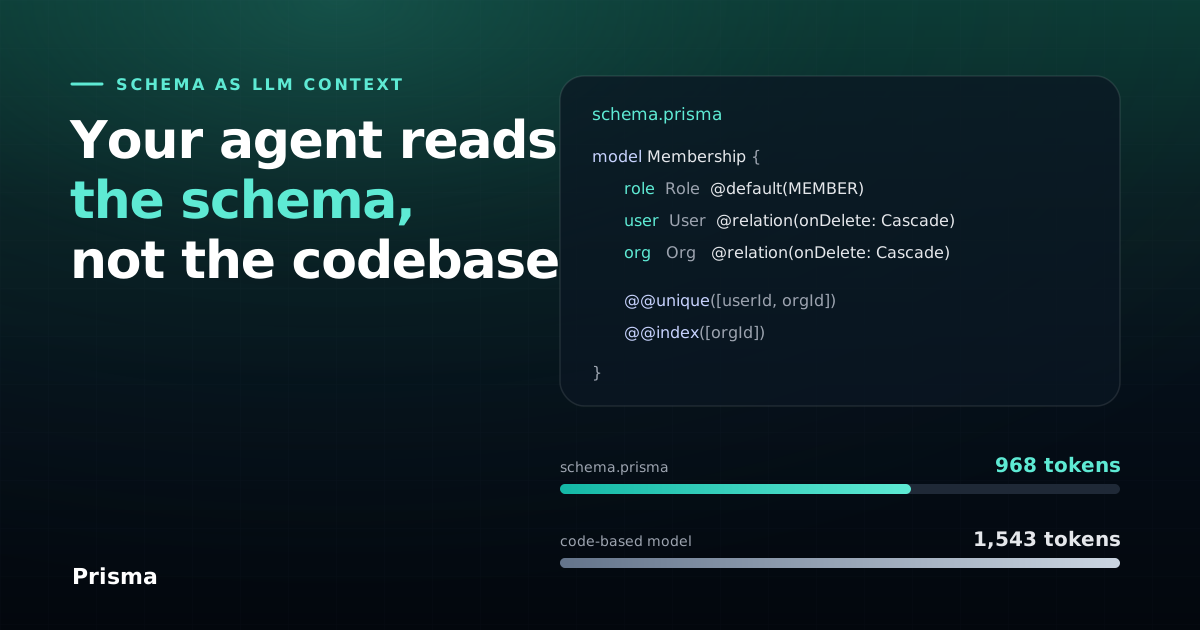
Why Your Agent Reads a Prisma Schema Better Than Your Codebase
Your data model in one declarative file. We measure what a Prisma schema costs an AI coding agent in tokens and type-check time, and what it buys.

Build your next app with Prisma
Start free. Scale when you’re ready.