

Evaluating Object Storage Providers for Prisma Compute

We built Prisma Compute, now in public beta, because existing serverless compute offerings felt too limited. It runs Bun in microVMs and uses automatic memory snapshotting, so it gives much of the feel of a long-running server with the pricing model of serverless.
Bun's batteries-included approach inspired us too. Over time, we want Prisma Compute to offer integrated solutions for email, auth, object storage, and more. This post is about one of those pieces: object storage.
As I write this, I have just begun a 16-hour flight across the Atlantic to San Francisco for AI Engineering World Fair, with Starlink holding up well enough to keep shipping. It is a good time to benchmark object storage providers for the kind of workloads we expect Prisma Compute to run.
What we cared about
AWS S3 set the standard for object storage, including the 11 nines of durability the rest of the industry later adopted. So our selection criteria came down to the areas that actually separate providers: price and performance.
We operate outside the AWS ecosystem, so the egress fees of the major clouds matter. The exact bill depends on region, tier, and volume, but public list prices still put common internet egress paths in the same rough cost class: AWS S3 pricing shows examples at $0.09/GB, Azure bandwidth pricing lists $0.087/GB for the next 10 TB from North America and Europe on the Premium Global Network, and Google Cloud Storage pricing treats network usage as its own pricing component.
That makes object stores with no egress charges especially interesting. Cloudflare R2 and Tigris both publish no-egress pricing, both are S3-compatible, and both are designed for large-scale usage outside a single hyperscaler. So those were the two providers I tested.
The workload
We are experimenting with ways to let agents work with large amounts of data on Prisma Compute. One experiment is accelerated-fs, a virtual filesystem implemented in TypeScript that uses a small local cache to provide fast access to a much larger dataset in remote object storage.
Think of an agent that needs to store and index all of your email locally so it can grep through it quickly. The useful interface is a filesystem. The durable backing store can be object storage. The hard part is making that feel fast when the working set is bigger than local disk.
That made accelerated-fs a realistic benchmark target. I had Codex create a small load-test app, deploy it to all six Prisma Compute regions, and collect the results.
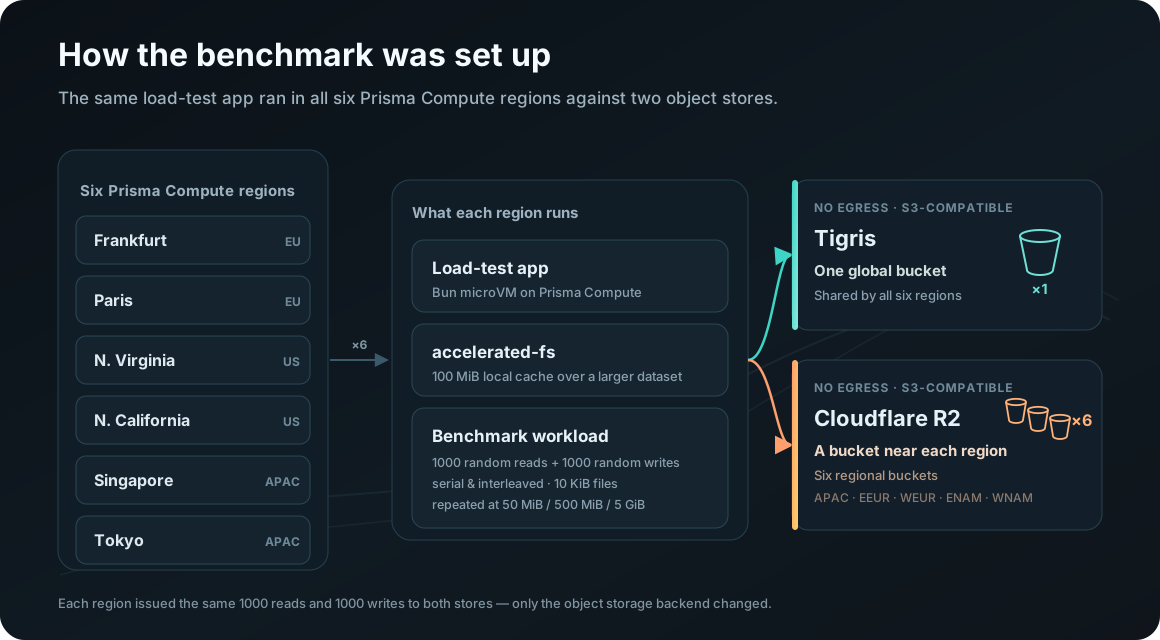
For each provider and region, the benchmark did the same work:
- Create
10 KiBfiles up to a configured dataset size. - Run
1000random reads and1000random writes. - Keep reads and writes serial and interleaved.
- Repeat the workload for
50 MiB,500 MiB, and5 GiB. - Use a
100 MiBlocal cache.
Tigris supports global buckets, so all regions used the same bucket. For R2, I created the bucket from the benchmark app so the bucket would be placed close to the Prisma Compute region running the test.
The result
For this workload, Tigris was clearly faster.
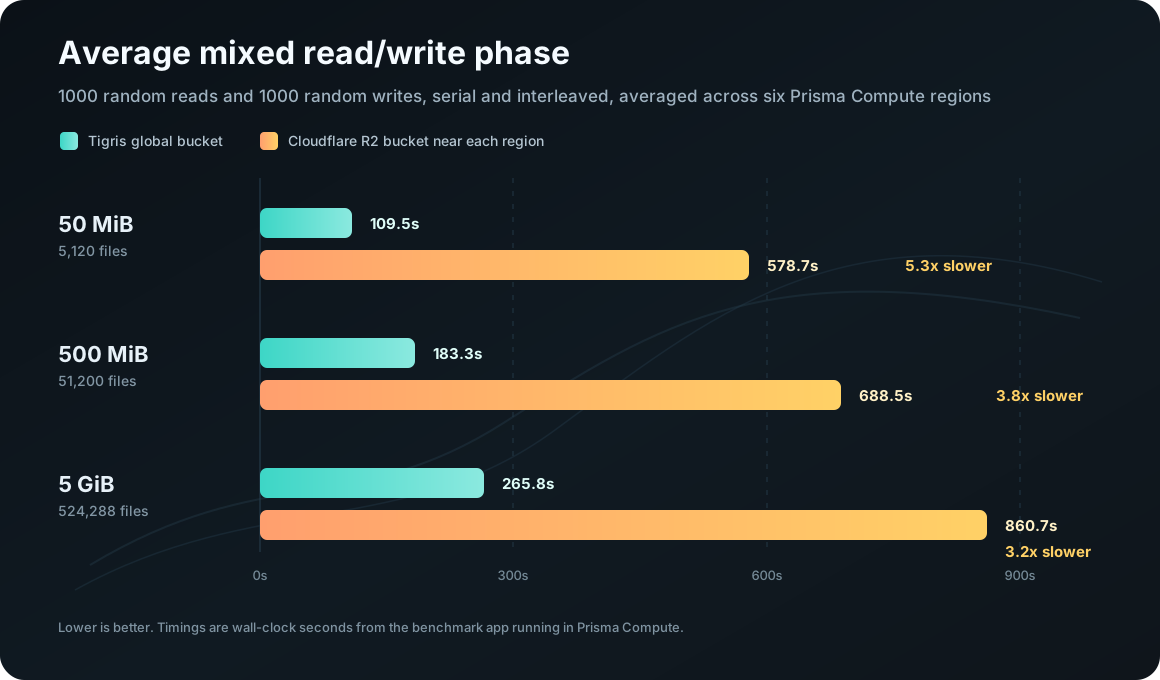
The main reason is that this benchmark is latency-sensitive, not just bandwidth-sensitive. After setup, it performs 2000 small serial operations against 10 KiB files. That punishes every extra remote round trip. Tigris' global bucket model handled that shape much better than R2's regional bucket model, even after we created R2 buckets from each Prisma Compute region.
The regional view makes that clearer. The mixed phase is where the latency gap shows up, so the compact version below focuses on that part of the benchmark. Timings are rounded seconds; each cell is Tigris/R2 (R2 slowdown).
Region         R2 loc  50 MiB           500 MiB          5 GiB
Singapore      APAC    62/765 (12.3x)   113/918 (8.1x)  147/1140 (7.7x)
Tokyo          APAC    82/498 (6.1x)    212/610 (2.9x)  332/773 (2.3x)
Frankfurt      EEUR    94/584 (6.2x)    184/682 (3.7x)  263/905 (3.4x)
Paris          WEUR    121/421 (3.5x)   220/532 (2.4x)  316/628 (2.0x)
N. Virginia    ENAM    216/438 (2.0x)   219/498 (2.3x)  304/686 (2.3x)
N. California  WNAM    82/767 (9.4x)    151/891 (5.9x)  233/1033 (4.4x)
Average        -       110/579 (5.3x)   183/689 (3.8x)  266/861 (3.2x)
The R2 location column matters: R2 did correctly create local-ish buckets in APAC, EEUR, WEUR, ENAM, and WNAM. So the issue was not simply that the bucket landed in the wrong part of the world. For this access pattern, the per-operation latency was still much higher.
The mixed-phase numbers tell you that Tigris was faster. The same run also recorded why, by sampling latency at two layers: the read latency accelerated-fs returns to the application after its cache, and the raw per-operation latency of the object store underneath it. The object store layer is where the gap is born.
| Workload | Tigris floor / avg / p95 | Tigris object reads | R2 floor / avg / p95 | R2 object reads |
|---|---|---|---|---|
| 50 MiB | 9.8 / 44.7 / 131 ms | 53.8 s | 43.8 / 90.6 / 171 ms | 143.0 s |
| 500 MiB | 9.8 / 56.3 / 181 ms | 66.4 s | 41.9 / 88.0 / 177 ms | 153.8 s |
| 5 GiB | 8.9 / 55.5 / 169 ms | 72.6 s | 44.4 / 105.7 / 237 ms | 229.7 s |
Two numbers explain the gap. Tigris' floor is about 4x lower: its quickest reads land near 10 ms, where R2's fastest sit around 44 ms. On a workload of thousands of small serial reads, that floor sets the pace. And because Tigris' average per-read latency is roughly half of R2's, the cumulative time spent reading from the object store comes out at 54-73 s against R2's 143-230 s, closely tracking the mixed-phase gap.
The cache helps both providers, but it cannot hide the floor. At 50 MiB, where the whole dataset fits inside the 100 MiB cache, the filesystem read latency accelerated-fs actually returns is well below the raw object latency: 29 ms p95 on Tigris and 107 ms p95 on R2. As the dataset grows past the cache, more reads fall through to the object store and the two layers converge. At 5 GiB the filesystem read p95 is 423 ms on Tigris and 436 ms on R2. Past the cache, you pay object store latency directly.
The in-flight benchmark
Since I was already on Starlink, I also ran the same workload from 36,000 feet. This is obviously not the environment Prisma Compute runs in, but I thought it would be a fun experiment. These are the timings of the 50 MiB mixed read/write phase.
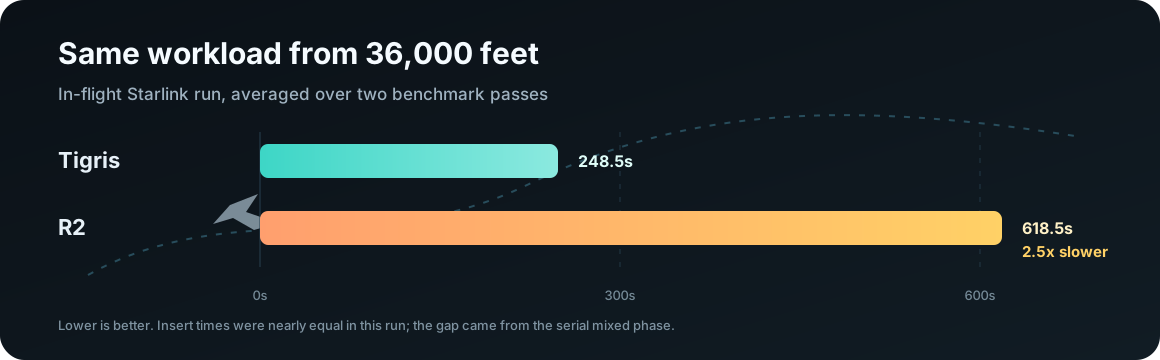
As before, R2 is much slower than Tigris, and both are much slower than the land-based version. Turns out fiber optic cables beat space lasers after all!
A baseline: the same stores from AWS Lambda
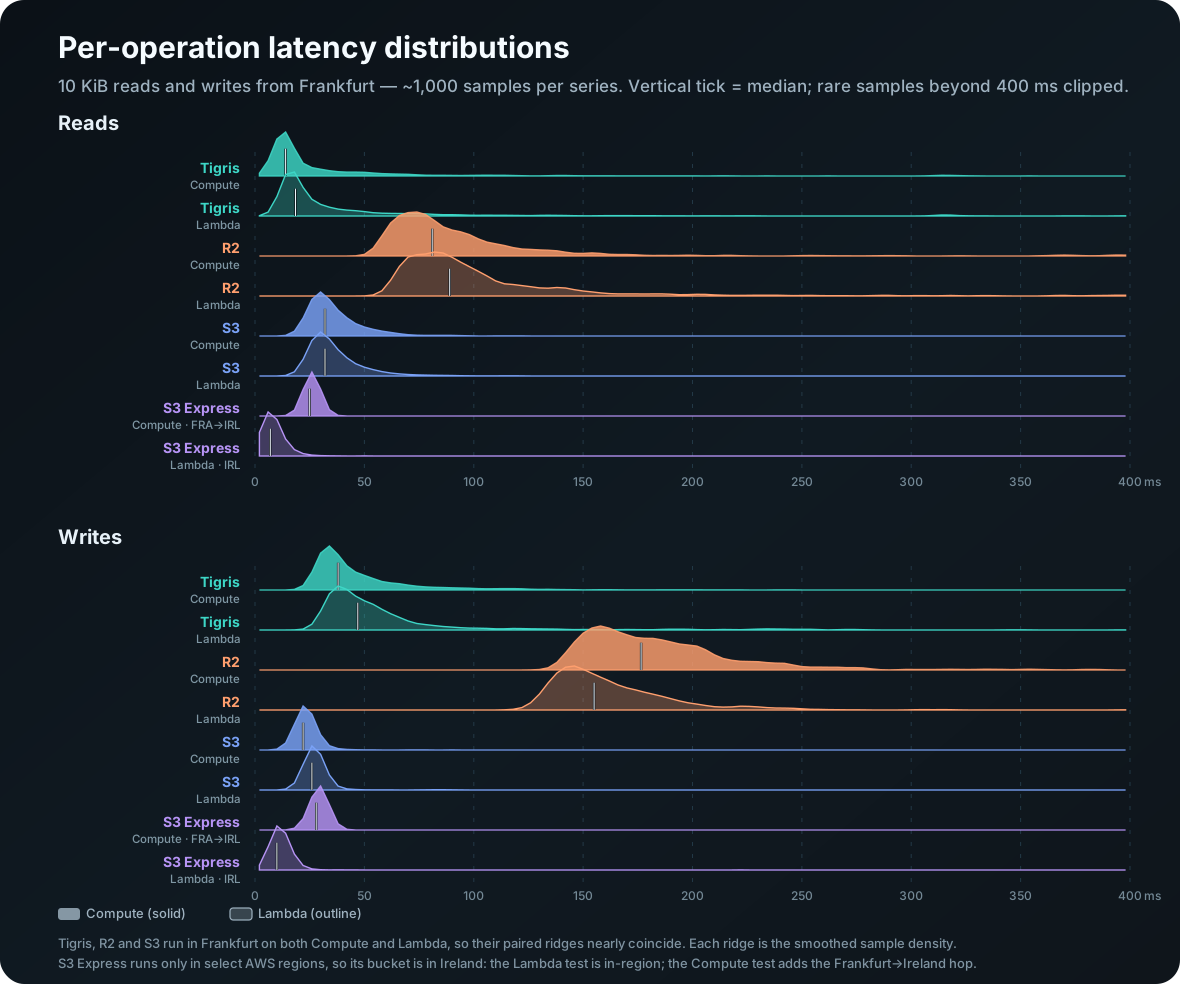
The numbers so far are aggregates. To see the full shape of the latency, and to check whether Prisma Compute pays any penalty reaching these stores, I ran a focused probe: 1,000 individual 10 KiB reads and 1,000 writes against each store, issued once from a Prisma Compute machine in Frankfurt and again, as a baseline, from an AWS Lambda function. The targets were the Tigris global bucket, an R2 bucket in EEUR, AWS S3 in eu-central-1, and S3 Express One Zone, AWS' low-latency, single-AZ storage class.
Three things stand out.
First, for the three stores available in Frankfurt (Tigris, R2, and standard S3), Prisma Compute and AWS Lambda behave almost identically. Each store's distribution looks the same from either client, and the paired ridges sit on top of each other: standard S3 reads, for instance, have a 32 ms median from both. Reaching these stores from Prisma Compute pays no platform tax. The gaps are between the stores, not the compute.
Second, the stores have very different shapes. R2 is the slowest and broadest, with read medians near 85 ms and write medians near 170 ms. Standard S3 is moderate, around a 32 ms read median, and unusually its writes run quicker than its reads. Tigris has the lowest typical latency of the Frankfurt stores, a read median of 14-18 ms, but a long tail, with roughly 1% of reads spiking past 300 ms. S3 Express One Zone, measured in-region, is faster and tighter than anything else: from a Lambda in Ireland its reads cluster around 7 ms with almost no spread.
Third, S3 Express comes with an asterisk. AWS offers it in only a handful of regions, none of them Frankfurt, so its bucket lives in Ireland (eu-west-1); the Lambda test runs there too, in-region, which is where that 7 ms comes from. Prisma Compute has no Ireland region, so its test reaches the same Ireland bucket from Frankfurt, and its S3 Express ridge sits near 25 ms. The extra ~18 ms is just the Frankfurt-to-Ireland round trip, not the store. Until there is a Compute region beside an S3 Express region, that hop is the cost of using it from Prisma Compute, on top of S3 Express being single-AZ and, unlike Tigris and R2, billing for egress.
A different axis: bulk throughput
Everything above is about latency, the time for one small operation. Bandwidth is a separate axis. A virtual filesystem occasionally has to move a large blob, not just 10 KiB files, so I ran one more probe across the same eight combinations: a single 50 MiB object, one PutObject and one GetObject per sample, 100 samples each.
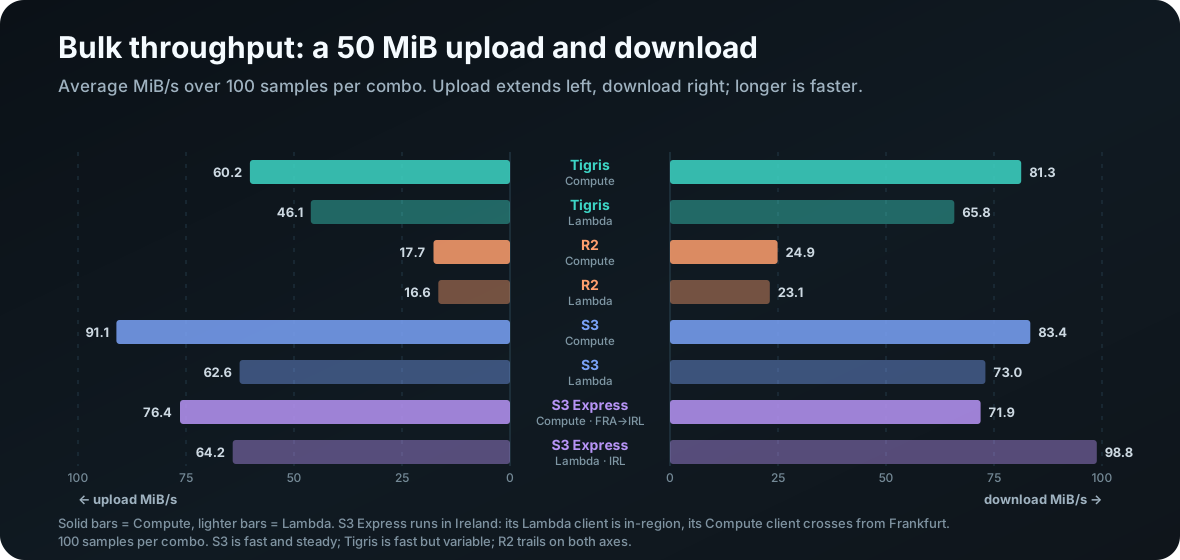
This axis tells a different story from the latency tests, though not a clean inversion. AWS S3, built for exactly this, is the throughput champion and the steadiest: about 91 MiB/s up and 83 MiB/s down from Compute. Tigris, which had the lowest per-operation latency, holds up well here too: about 60 MiB/s up and 81 MiB/s down from Compute, its download nearly matching S3, though its spread is wide. S3 Express from Compute lands around 76 MiB/s up and 72 MiB/s down. The clear laggard is R2, at roughly 18 MiB/s up and 25 MiB/s down from Compute, the same store that trailed on latency, and it still downloads noticeably faster than it uploads.
Two details stand out. First, Compute and Lambda diverge here, where for latency they were nearly identical. For the three Frankfurt stores (Tigris, R2, and standard S3), Compute is the faster client, moving more data than an in-AWS Lambda in every case. The likely cause is raw network bandwidth: an AWS Lambda's throughput scales with its memory size, while a Compute machine has its own pipe. On this axis the result says as much about the client as the store. (S3 Express is the exception, but only because its Lambda client sits in-region in Ireland while its Compute client crosses from Frankfurt, as noted above.)
Second, latency and bandwidth are decoupled. S3 Express still moves a respectable ~76 MiB/s up and ~72 MiB/s down from Compute even though that path crosses from Frankfurt to Ireland and pays a heavy per-operation latency penalty. For a single large transfer you pay the round trip once and then stream, so the cross-region hop that dominated the small-object workload barely dents bulk throughput.
Across 100 samples per combo, the spread is as revealing as the averages. S3 from Compute is rock-steady: its uploads ranged only from 82 to 93 MiB/s. Tigris from Compute is fast on average but highly variable: uploads swung from 20 to 96 MiB/s and downloads from 39 to 158, so its headline numbers sit on top of a wide distribution. R2 is slow on both axes, and not especially steady either.
What this means for Prisma Compute
This is not a universal object storage benchmark. It does not say that every app should pick Tigris over R2. If your workload is mostly bulk upload and download, where S3 pulled well ahead, or if your application already lives inside Cloudflare's network, your results may look different.
For accelerated-fs, Tigris is the better fit today. It gave us one durable shared bucket, no egress fees, and much lower latency on the serial small-object workload that agents are likely to create when they use object storage as a backing filesystem. The AWS baseline reassured us on the platform question: for stores that run in the same region, Prisma Compute reaches them just as quickly as an in-AWS Lambda function does. The latency is the store's, not a penalty for running outside AWS. (S3 Express is the lone exception, and only because AWS doesn't offer it in Frankfurt.)
We will keep benchmarking as we build more of Prisma Compute's integrated platform services. The important part is to benchmark the thing you actually plan to run. In this case, that meant many small files, tested for both latency and throughput from all our regions. This was an interesting first dataset, and we will keep evaluating Tigris before integrating it directly into Prisma Compute.
About the author
Søren is a co-founder of Prisma and previously co-founded Graphcool, the GraphQL backend platform that grew into Prisma. Before founding companies he worked as a software architect at Trustpilot, and he has spent well over a decade building tools that simplify how developers work with data. He writes about databases, developer tooling, and the direction of modern application infrastructure.
Keep reading

App Hosting and Compute Platforms for AI Agents in 2026
A field guide to the 2026 wave of app-hosting and compute platforms (Prisma Compute, Neon, Cloudflare Containers, Hosting.com, Unkey, and Insforge) and how close each gets to one coherent stack for agents.

Infraslopture and Other Paradoxes
How we're combining untrustable agents and production infrastructure without burning down our servers

Build your next app with Prisma
Start free. Scale when you’re ready.