

Prisma 7 AMA: Clearing Up the Why Behind the Changes

Prisma 7 is a structural release focused on long-term architecture rather than surface-level features. Some things improved, others became stricter. This post answers questions from our recent AMA on X and explains where Prisma 7 stands today and where it’s headed.
During the Prisma 7 AMA on X, we saw a mix of excitement, curiosity, and very valid frustration. Below, we’re answering the questions exactly as they were asked, linking to the original posts, and adding the engineering context we owe you.
Questions we’ve previously received from the community
Some of these questions came up during the AMA, others earlier. We’re grouping them here to give a clearer, more complete picture of Prisma 7.
Prisma 7 vs Prisma 6 performance: is it faster or slower?
This depends heavily on how you measure performance.
Prisma 7 performs significantly better in some areas:
- Working with large result sets
- Sending raw queries
- Avoiding overhead from cross-process communication
There are also cases where throughput is similar or slightly worse. The main reason is architectural: Prisma 7 now communicates with the database from JavaScript, rather than a separate multi-threaded Rust runtime.
That shift trades peak parallelism for:
- Better integration with modern JS runtimes
- Simpler deployment in serverless and edge environments
- More predictable behavior across tooling and bundlers
So if your workload is data-heavy or raw-SQL-heavy, Prisma 7 often wins. If your workload previously benefited from Rust-level threading, you may see parity or regressions.
This was a deliberate trade-off, not an oversight. We’re continuing to improve performance in Prisma 7, as seen in the 7.3.0 release, with more incremental improvements on the way.
Does Prisma 7 support MongoDB and other databases?
MongoDB is not supported yet.
Today, Prisma 7 treats:
- PostgreSQL
- MySQL
- SQLite
- MariaDB
MS SQL Server, PlanetScale and CockroachDB are supported as well.
MongoDB didn’t make this release because the architectural changes in Prisma 7 required deep rework at the query layer, and SQL databases were prioritized. This isn’t a permanent statement about MongoDB. Bringing MongoDB support back is a priority, but it isn’t available today.
Why was prisma.config.ts introduced in Prisma 7?
The original goals for prisma.config.ts were:
- Centralize Prisma configuration
- Declare Driver Adapters for introspection and migrations
- Act as a stable entry point for Prisma ORM
We didn’t fully achieve that vision.
The Driver Adapter flow for introspection and migration was scrapped, which means part of the original purpose of prisma.config.ts isn’t realized yet.
What did land:
- Centralized configuration for Prisma tooling
- A clean separation between runtime-dependent code and development-time concerns
Today, prisma.config.ts effectively represents what we used to call the Prisma Development Kit. The direction was right. The execution is still in progress.
Difference between prisma-client-js and the new prisma-client generator
prisma-client-js was designed when:
- Node.js was the primary runtime
- Runtime inference happened implicitly
- Bundlers and edge environments were not first-class concerns
The new prisma-client generator is built for Prisma 7’s architecture:
- Designed around the Query Compiler
- Explicit about the code it generates
- Compatible with modern JS runtimes, bundlers, and meta-frameworks
- TypeScript-only, by design
This is a shift away from magic toward explicitness. Fewer guesses, clearer contracts, and more predictable behavior across environments.
Questions we received on X
Below are questions asked directly during the AMA.
Why Prisma uses PGlite for development but doesn’t provide a dedicated adapter
Honest answer: a dedicated PGlite adapter was never prioritized.
We had planned to publish a guide on writing Driver Adapters around the Prisma 7 release, but that work was deprioritized due to other commitments.
The good news is that PGlite works with the PostgreSQL adapter. When starting prisma dev from the CLI, select “Print TCP URLs” and use the generated URLs with the existing pg adapter.
How to switch database connection strings programmatically in Prisma 7
If this refers to dynamically switching database URLs at runtime, that pattern still exists, but Prisma 7 pushes you toward a more explicit model.
The recommended approach now is:
- Use multiple adapters
- Create multiple Prisma Clients
- Be explicit about which database each client targets
Dynamically swapping connection strings adds complexity around pooling, caching, and compilation, especially in modern runtimes. Prisma 7 optimizes for predictability over flexibility-by-default.
That said, the ergonomics here can improve, and this feedback is noted.
How query plan caching works in Prisma 7.4.0
This one deserves its own deep dive, and it’s coming soon with the 7.4.0 release.
The short version is that Prisma 7 will soon cache compiled query plans and reuses them across repeated queries. Since the query compiler runs on the JavaScript main thread, this removes most of the compilation overhead after the initial warm-up and brings performance back in line with Prisma 6. We’ll cover how this works in detail in a separate blog post.
Why certain relationship features were removed in Prisma Studio v7
The current Studio release is primarily focused on:
- Improving embeddable capabilities
- Supporting MySQL and SQLite
- Overall UI and UX improvements
We know some familiar features didn’t make it into this release. Further enhancements are planned and will roll out over time. This isn’t a finished state, it’s a foundation we can now iterate on more safely.
We care deeply about Studio, and there is a clear plan moving forward.
Will Prisma make it easier to use raw or partial SQL in future versions?
Yes, we’re actively working on this.
Typed SQL is powerful, but it doesn’t cover everything:
- PostGIS
- Advanced database-specific features
- Complex conditional logic
We’re exploring better ways to bring structured Prisma queries with raw or partial SQL. This work is scoped for a future major version, because it touches core internals.
Final thoughts
Prisma 7 is not about small visual changes. It’s about building a strong foundation for new runtimes, new deployment models, and real-world workloads.
Some parts are still rough, and we take responsibility for that. Your feedback matters to us and is already helping shape what we improve next. Thank you for your patience and for building with Prisma.
About the author
Ankur is a member of the Prisma team who works closely with the developer community, with hundreds of contributions across Prisma's open source repositories and a background that includes founding an ed-tech startup. He writes about TypeScript, Node.js, PostgreSQL, and modern application stacks.
Keep reading
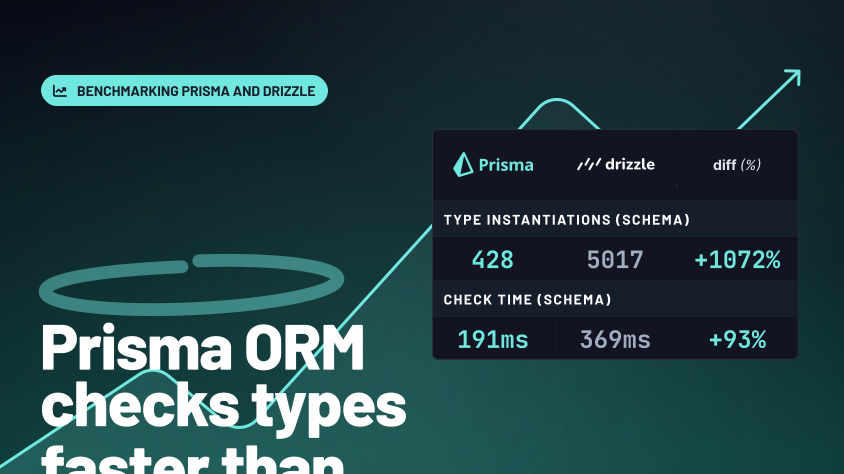
Why Prisma ORM Checks Types Faster Than Drizzle
Discover why Prisma ORM outperforms Drizzle ORM in TypeScript type checking. Our benchmarks show Prisma checks queries 72% faster on average, thanks to code generation that keeps editors snappy and CI runs smooth.

Prisma ORM v6.14.0, Relationships for SQL Views, More Robust Management API & More
We just released Prisma ORM v6.14.0 with the ability to define relations across views, a robust API for programmatically provisioning Prisma Postgres & more.
Build your next app with Prisma
Start free. Scale when you’re ready.